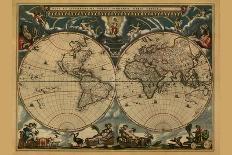
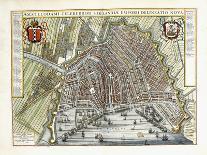
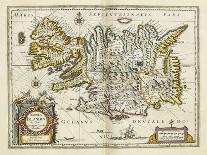
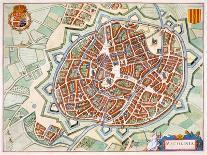
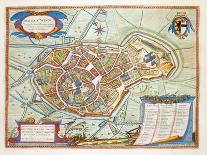
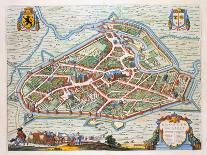
Highly decorative, Joan Blaeu’s (1599 – 1673) “Map of the World” exemplifies the flamboyant artistic skills that made him the 17th century’s premier mapmaker. Filling the void left by the death of renowned cartographer Jodocus Hondius II, Blaeu created an extraordinary, multi-volume world atlas published in six languages, which contained 3,000 pages of text and 600 maps. “Map of the World” typifies the exceptional engraving, colors and typography which transformed Blaeu’s maps into works of art.
Joan Blaeu (1599 – 1673) transformed mapmaking into an art form while running the 17th century’s largest printing press, and was also the Dutch East India Company’s principal cartographer. After the death of Jodocus Hondius II, Blaeu replaced him as Europe’s most renowned mapmaker by printing an extraordinarily beautiful world atlas, Theatrum Orbis Terrarum or Atlas Major. Primarily used for display by wealthy clients, it was the 17th century’s most expensive book, containing over 3,000 text pages and about 600 maps. The largest output of Blaeu’s printing press was 1 million impressions from 1,000 copper plates within four years.
This art print displays sharp, vivid images with a high degree of color accuracy. A member of the versatile family of art prints, this high-quality reproduction represents the best of both worlds: quality and affordability. Art prints are created on paper similar to that of a postcard or greeting card using a digital or offset lithography press.